
Today

I’ve opened my securities portfolio ... now what?

Have you just opened your securities portfolio? Congratulations! That's an important first step. But suddenly, a whole series of questions may start running through your mind: "What do I do now?", "What if I make a mistake?" or even "What if I lose money?". Rest assured, these questions are completely normal. Almost everyone has these concerns when they start investing. Investing is not a skill we are born with, and nobody instinctively knows what to buy or when the best time to invest is. The good news is that you don't need to be an expert to get off to a good start. In this article, we'll share a few useful tips.

What is an investment strategy?

When we talk about an investment strategy, we're not talking about complex calculations or risky decisions. It simply comes down to answering three straightforward questions: 

  1.  Why am I investing?
  2.  How long do I plan to invest for?
  3.  How can I get started without feeling overwhelmed?

A strategy is not about trying to find the perfect opportunity. Instead, it's about deciding in advance how you'll move forward step by step, even when markets fluctuate, so that you always have a plan in mind.

1. Why invest? The reasons that led you to open a securities portfolio

Before thinking about products or markets, remind yourself why you opened a securities portfolio in the first place.  For many beginners, the reasons are quite simple: 

  •  To give their savings the opportunity to grow more than they might in a traditional savings account.
  •  To prepare for a long-term project.
  •  To avoid inflation gradually eroding the value of their money.

For example, in recent years, rising energy and food prices have made many people realise that leaving all their money in a savings account may not be ideal in the long run. Inflation can cause money to lose purchasing power over time and does not benefit from market growth opportunities.

2. How long should you invest for: setting clear and realistic goals

Defining your goals doesn't have to be complicated. Simply start with something concrete and personal, without necessarily putting an exact figure on it. A clear goal combined with a time horizon is often enough, for example: 

  •  Building up capital for a project in 10 or 15 years' time.
  •  Investing part of your savings for long-term growth instead of leaving it idle in an account.
  •  Building a financial cushion for retirement.

Generally, the further away your goal is, the more time you may have to ride out fluctuations in the value of your investments. 

A very concrete and recent example: 

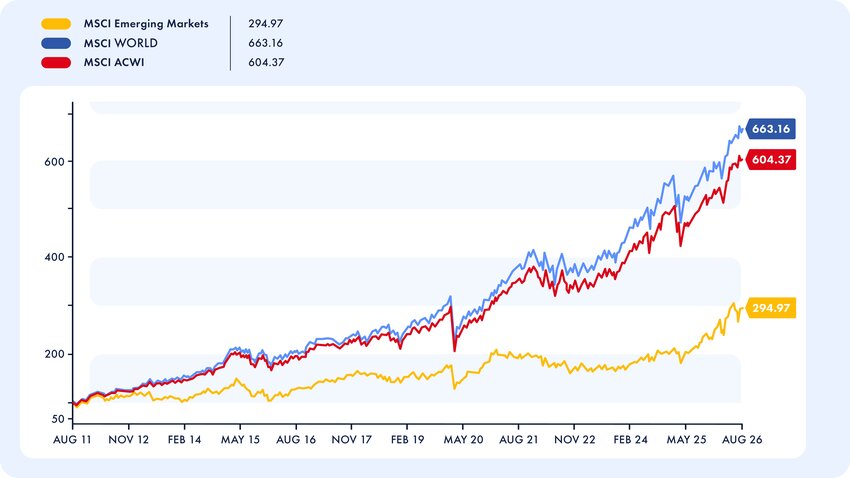
In recent years, financial markets have experienced periods of decline linked to inflation and central bank decisions. Short-term investors have sometimes panicked when seeing temporary losses. Long-term investors understand that such movements are a normal part of the investment journey.

Long-term market growth despite crises

Chart 1

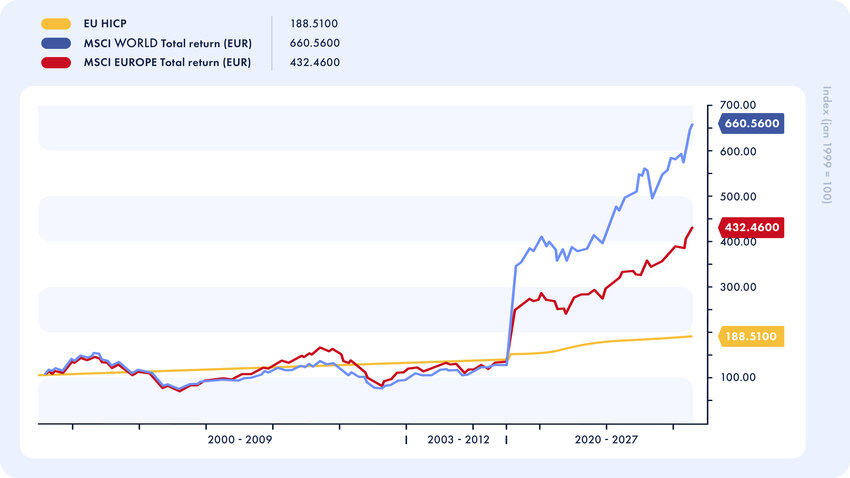
Past performance does not guarantee future increases in portfolio value. Losses cannot be ruled out and do not engage the responsibility of Spuerkeess. Future returns depend primarily on developments in financial markets. 

The impact of time on investing versus inflation

Chart 2

3. How to get started: taking the first step

When you're new to investing, the temptation is often either to do everything at once or to do nothing at all.

A good first step can be very simple: start with a modest amount that you feel comfortable investing. A useful tip for beginners is to choose a diversified investment rather than putting all of your money into a single company.

For example, instead of buying shares in one individual company, some beginners start with a fund that invests across multiple companies, sectors and countries.

This can help you learn how markets work without putting all your eggs in one basket.

Diversification explained without the jargon

Diversification may sound complicated, but the idea is actually very simple. Imagine investing all of your money in:

  • one company, or
  • one single sector, such as energy.

If that company or sector faces difficulties, your entire investment is affected.

To reduce this risk, it can be beneficial to spread your investment across:

  • several companies,
  • different countries,
  • various sectors (technology, healthcare, energy, etc.).

Today, for example, some sectors linked to the energy transition are growing, while others are slowing down. Diversification helps reduce dependence on a single scenario.

It can also help reduce stress by smoothing out some of the ups and downs.

What if I'm afraid of getting it wrong?

This concern is perfectly normal. Investing always involves some degree of risk, but doing nothing also carries a risk, particularly because inflation can reduce the purchasing power of your savings over time.

The good news is that you don't need to invest everything at once, nor do you need to take excessive risks to get started.

Starting small is a valid strategy. You can thus choose to:

  • invest an amount you are comfortable with,
  • monitor how it develops,
  • learn as you go,
  • adjust your strategy over time.

You've already taken the first step by opening your investment account. The rest will fall into place naturally, one step at a time. 


Golden rules for getting started with investing:

  • Keep your investment goals in mind.

  • You don't need to be an expert to get started. 

  • Choose a simple and well-thought-out strategy rather than making decisions based on fear. 

  • Invest for long enough to ride out market ups and downs. 

  • Remember this: investing is not a straight line. It's a journey with twists and turns. 

Investment information request

Be contacted by an advisor

Format: DD.MM.YYYY

Format: email@example.com

Phone number
+

Format: 123 456

Preferred communication channel

You might also like

START2INVEST Investments