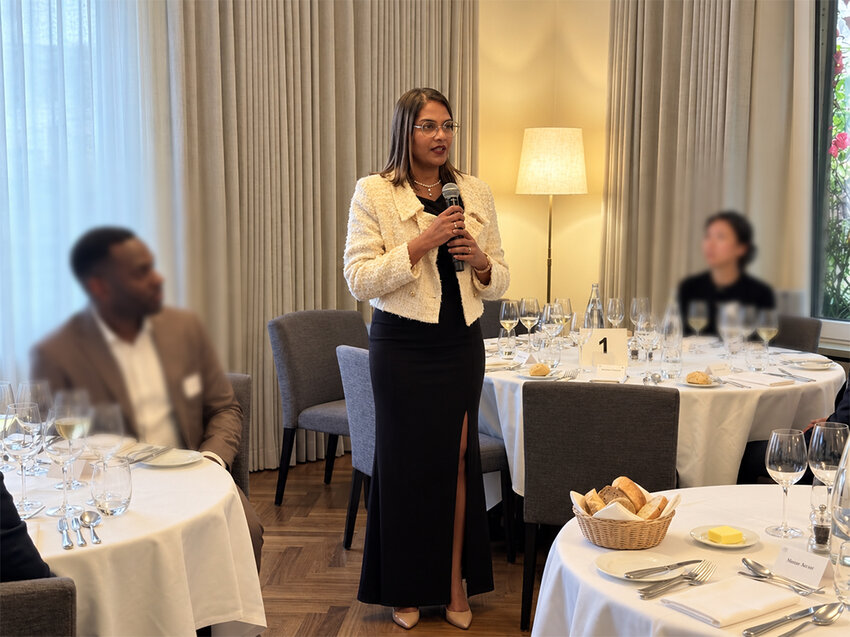
Harika: Of course! I think there are four principal axes to watch in this business over the next decade for fund finance in general.
First, new money. For thirty years this was a humble bank product, full stop. Today rated facilities are commonplace, funds dedicated to investing in subscription lines are being launched, including here in Luxembourg, and syndicates increasingly include a non-bank name. So, the first point I wanted to make was about this influx of non-bank names into the lender list. This also outshines the real value of choosing a bank to accompany a fund through its whole journey: a stable balance sheet, a single person of contact that covers various banking products and services; and a credit banker who understands the client’s ambition and can be relied on when a capital call runs late.
Second, new borrowers. The classic subscription line was built for a typical closed-ended fund with forty institutional investors and a ten-year life. The funds being launched today seldom follow this trend. Evergreen structures. Semi-liquid vehicles. ELTIFs sold to private clients through a bank network. Investors in the thousands rather than the dozens. The borrowing base is evolving, and lending against thousands of individual commitments, with redemption windows instead of a fixed investment period, is a different job: eligibility criteria, concentration limits and liquidity all need to be rethought. This is where Luxembourg, with its decades of retail fund plumbing, has a natural advantage, provided lenders and depositaries sit together early, rather than after the prospectus has been finalised.
Third, the family grew. Ten years ago, if you said fund finance in this city, you meant a subscription line. Today the sub line is the eldest child of a whole family. When the investment period ends and the uncalled commitments are gone, the NAV facility takes over, lending against the portfolio itself: almost exotic a decade ago, it is now a market well beyond the hundred-billion mark, expected to grow several times over by the end of the decade. In between sit the hybrids, which start on commitments and slide onto the portfolio as the fund matures, so one lender can accompany a fund from first closing to final distribution. And further up, the managers themselves have become borrowers: management fee lines, GP commitment financing, carry facilities, working capital for a management company whose regulatory to-do list gets longer every year. The client is no longer a fund, it is an ecosystem, and the lender who only knows one product needs to evolve, which is exactly what our team at Spuerkeess is in the process of doing.
Fourth, new rules. Regulation is moving on several fronts at once, and each of them ends up affecting the credit agreement. Then there is the Basel package, which is slowly making undrawn commitments more expensive for banks and pushes everyone towards relationship lending and risk transfer. And finally, CRD VI. From January 2027, a non-EU bank lending to a Luxembourg fund will, in most cases, need a European branch or subsidiary, or a structure around it. The jurisdiction of the loan is now a term sheet discussion, and every accordion or extension of an older facility deserves a quick look. This is where Spuerkeess, as a Luxembourg bank with a long track record and a stable structure, can welcome new funds with confidence.
Philippe: Very well said. I do believe funds with a longstanding banking relationship benefit from a full suite of banking services, and from a level of accountability that is hard to replicate outside a regulated bank. We also have a team dedicated to fund financing, our Lending – Fund Finance team within Institutional Relationship Management, which can help the client structure equity bridge facilities alongside the depositary, custody, cash management and FX hedging services the fund already uses, all followed closely by one relationship manager. What about the second topic on insurance companies, what did you take away from that?
Harika: Oh, that one was presented by Victoria Stewart on the role of insurance companies in fund finance. I think it is a very relevant question, which has seldom been posed to the Luxembourg market in a discussion forum before. My first thought was risk transfer in the light of Basel IV, but the expert audience came up with many other interesting roles for an insurer in this industry. Do you agree?
Philippe: I do. What interested me most was the idea that the fund finance ecosystem is constantly evolving, with new participants and sources of capital emerging alongside traditional players. Whether insurers will ultimately play a significant role in Luxembourg is something the market will determine, but it was certainly a thought-provoking discussion. And the last topic was one of the most interesting for me: AI in fund finance. Do you remember the discussion?
Harika: Yes, indeed. I was completely hooked on the points made by Dr. Esli Spahiu, who leads the AI Experience Centre at the LHoFT, on how AI has been slowly and silently reshaping finance in general. Her thoughts on accountability and differentiation particularly struck me. It made me wonder: if everybody ends up using the same tools, what will make a lender different, and who answers for the decision? I also started thinking about how AI could help us in fund finance: investor analysis for a subscription facility, reading through side letters, facility management, loan monitoring and quarterly reviews. Do you know more about how Spuerkeess is evolving on this topic?
Philippe: At Spuerkeess, we have chosen to take AI step by step rather than chase the trend. We started by training our people on the basics, the risks and the right uses, while continuing to strengthen the data foundations that are essential for any successful AI initiative.
Across the bank, many potential use cases have been identified and are assessed based on their feasibility, regulatory requirements and the value they can bring to our clients and our teams. Some are already delivering tangible benefits, for example in areas such as risk management and operational efficiency, and every use case is carefully reviewed before implementation. We have also created Think Sphere, a dedicated subsidiary to explore new technologies, including AI agents. But one principle does not change: AI is a tool that helps our people work more efficiently and focus on higher-value activities. The human remains accountable for the decision, especially when it comes to lending and risk taking. That is also part of the answer to your differentiation question: technology may become widely available, but judgment, experience and client relationships will remain key differentiators.
Harika: So, back to my first question: what do you tell a crowd of experts about the evolution of their own business? Perhaps simply that the humble subscription line is not so humble anymore. It has new lenders, new borrowers, a growing family, a new rulebook and, soon, new tools. What has not changed is what the evening reminded all of us: this is a relationship business, and Luxembourg is at its best when lenders, managers, depositaries and advisors sit at the same table early. We are already looking forward to the next edition of the event.
Would you like to discuss the financing needs of your fund? Our Lending – Fund Finance team will be happy to hear from you.


![[Translate to English:]](/fileadmin/_processed_/8/1/csm_image_plan_de_financement_BCEE_059bfe194a.jpg "[Translate to English:]")

![[Translate to English:]](/fileadmin/_processed_/7/b/csm_444_FIN_Acheter_ou_louer_avantages_logement_46b7cb8e32.jpg "[Translate to English:]")
![[Translate to English:]](/fileadmin/_processed_/8/f/csm_218__STI__ouvrir_et_gerer_un_portefeuille-titres_142cd029f7.jpg "[Translate to English:]")

![[Translate to English:]](/fileadmin/_processed_/c/1/csm_452_FIN_fraude_facture_17juin26_b4395d5ac3.jpg "[Translate to English:]")

![[Translate to English:]](/fileadmin/_processed_/f/f/csm_451_FIN_jeunes_actifs_declaration_impots_2_e29be3eb82.jpg "[Translate to English:]")
![[Translate to English:]](/fileadmin/_processed_/9/b/csm_450_FIN_mobilite_change_de_vitesse_a51518e4a7.jpg "[Translate to English:]")

![[Translate to English:]](/fileadmin/_processed_/4/f/csm_425_FIN_3_raisons_de_faire_sa_declaration_maintenant_3a63d0178a.png "[Translate to English:]")
![[Translate to English:]](/fileadmin/_processed_/3/7/csm_448_FIN_Fonctionnalites_S-Net_Business_A_0eb4ec356a.jpg "[Translate to English:]")
![[Translate to English:]](/fileadmin/_processed_/4/9/csm_443_Marc_et_Sophie_S-Pension_8eb784f1c7.jpg "[Translate to English:]")

![[Translate to English:]](/fileadmin/_processed_/3/2/csm_446_S_M_Le_grand_saut_vers_le_premier_logement_7116ee6967.jpg "[Translate to English:]")


![[Translate to English:]](/fileadmin/_processed_/6/c/csm_367_FIN_S-Pension_non_residents__1__7ed60e51c2.jpg "[Translate to English:]")