The Return of Diversification
Investment Update | November 2026
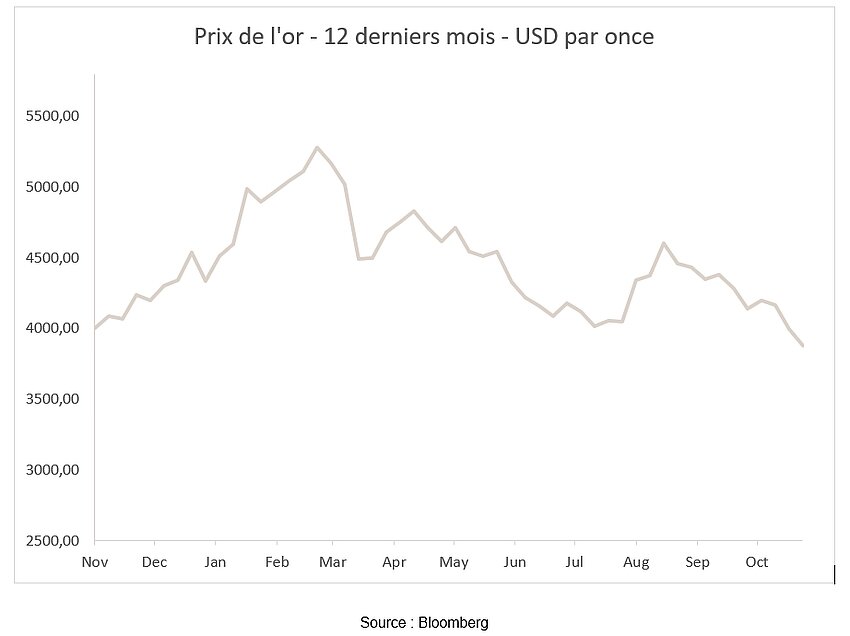
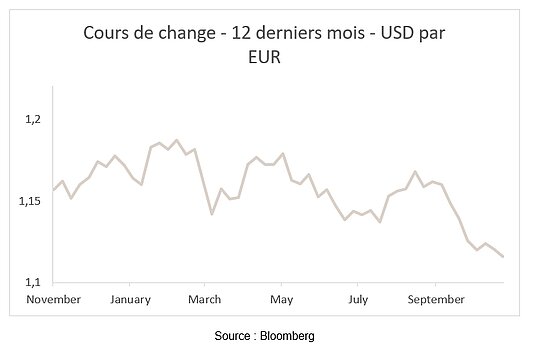
October ended in a more mixed market environment, marked by a pronounced rotation within equity markets and a notable easing in sovereign bond yields. Global equities proved broadly resilient, with the MSCI World posting a modest gain of +0.91% in euro terms, supported by favourable currency effects by month-end. Yet beneath this apparent stability, substantial movements occurred across regions, sectors and investment styles. Several AI-related technology stocks experienced sharp corrections, although European investors were partly shielded by the euro's 1% depreciation against the US dollar. guidancDespite significant sector rotation, the US market declined by only 0.8% in US dollar terms, translating into a gain of 0.90% in euros, whereas technology-heavy indices suffered much more pronounced losses. Emerging markets were also heavily affected, with the MSCI Emerging Markets Index falling by around 8%*, mainly due to weakness in Asian technology-exposed markets such as South Korea and Taiwan.
Indeed, more than the direction of the indices themselves, it was the internal market rotation that dominated October's headlines. Value stocks outperformed Growth stocks, highlighting a clear broadening of market performance beyond the largest technology companies. Overall, the decline in AI-related stocks reflects growing concerns over the profitability of the substantial investments being made in infrastructure, data centres and semiconductors.
In bond markets, developments moved in the opposite direction to those seen at the end of September. Having reached 5.29%, the yield on the US 10-year Treasury bond declined to around 4.93% by the end of October (-35 basis points). In Germany, the 10-year Bund yield fell from 3.59% to 3.32%. Sovereign bonds benefited from increased demand as equity market volatility rose and investors sought higher-quality assets. France remained the notable exception. Concerns surrounding the country's fiscal trajectory and political situation continued to weigh on French government debt, pushing the yield spread between French and German 10-year bonds to approximately 166 basis points. European financial stocks were also affected by contagion and declined by more than 5%.
On the central bank front, the US Federal Reserve (Fed) kept its target interest rate range unchanged at 3.75%-4.00% following its meeting on 28 October. This decision was not universally supported, given that inflation remains above target. Similarly, the European Central Bank (ECB) left its deposit rate unchanged at 2.50% following its meeting on 29 October. The ECB also emphasised that higher energy prices represent both an upside risk to inflation and a downside risk to growth. As a result, the ECB continues to adopt a data-dependent approach without providing forward guidance on the future path of interest rates.
From a macroeconomic perspective, the US economy remains particularly robust, with investment and consumer spending providing strong support for activity. Estimated annualised GDP growth reached 3.4%, compared with 2.2% in the previous quarter. The main concern remains inflation, which continues to run at elevated levels. September consumer prices increased by 3.7% year-on-year, while core inflation stood at 2.6%.
Within the euro area, estimated annualised GDP growth of 1.3% suggests greater resilience than expected. However, it should be noted that this figure is significantly distorted by exceptionally strong growth in Ireland. Inflation continued to accelerate, rising from 3.2% in August to 3.8% in September, mainly driven by higher energy prices.
Finally, oil remains a key focus for financial markets. Ongoing tensions in the Middle East pushed Brent crude prices close to USD 118 per barrel by the end of October. Persistently elevated energy prices continue to complicate the task of central banks by sustaining inflationary pressures, although their full impact on economic activity remains difficult to assess.
Against this backdrop, portfolio positioning remains favourable towards risk assets while maintaining a more selective approach. Equities continue to be preferred over bonds. The recent correction in certain technology stocks does not undermine the long-term structural theme of artificial intelligence, but it reinforces the need to favour companies capable of demonstrating adequate returns on their investments. Exposure to Industrials and Technology is therefore maintained, as is a preference for European and US banks, despite increased volatility among European financial stocks. From a geographical perspective, positioning remains broadly neutral, with an overweight allocation to the United States. The strength of the US economy and earnings growth remains supportive, although current valuation levels call for greater selectivity. Positions in Biotechnology and small and mid-cap equities remain more constrained.
Within the fixed income allocation, credit remains the preferred asset class. The recent decline in yields has also improved the attractiveness of sovereign bonds, although the carry offered by credit continues to be appealing. Caution is still warranted regarding long maturities, given that inflation remains above central bank targets and public sector financing needs remain elevated.
*Performance figures are calculated in euros.
Equity Markets
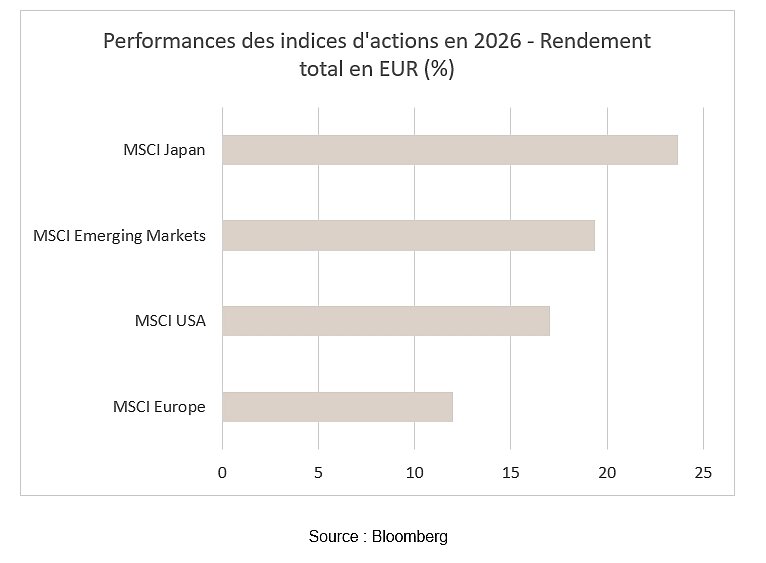
October once again highlighted the contrast between the apparent stability of broad market indices and the significant sector rotation occurring beneath the surface. Major developed market indices displayed relative resilience, although performance dispersion across factors and regions remained substantial. The MSCI World advanced by 0.91%, while the MSCI Europe gained a stronger 2.17% and North America rose by 0.90%. By contrast, emerging markets experienced a pronounced correction, with the index falling 5.09%. China was among the weakest performers, declining 5.41%* over the period.
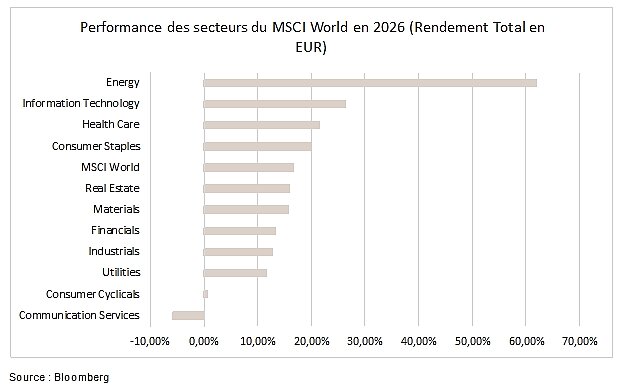
Relatively sheltered from the unwinding of AI-related trades, the European market benefited from a sector composition well suited to the defensive rotation. The Healthcare sector rose 14.09%, narrowly outperforming Consumer Staples, which gained 12.09% during the month. These gains more than offset weakness in the banking and industrial sectors. Earnings revision momentum also remains positive in Europe, reinforcing the region's relatively resilient profile.
In the United States, factor dynamics differed markedly from those observed during the summer. Markets reverted to a more traditional "Risk-On/Risk-Off" framework, which naturally favoured defensive sectors. US indices experienced a significant internal correction, reflected in the underperformance of Communication Services and Technology stocks. This move was driven primarily by a large-scale unwinding of positions linked to the artificial intelligence theme. While the ongoing earnings season has confirmed solid underlying fundamentals, investors remain increasingly sceptical about the rapidly rising investment programmes of hyperscale technology companies, resulting in substantial outflows from the sector.
October therefore marks a further stage in the maturation of the market cycle. Limited short-term visibility argues in favour of a cautious wait-and-see approach, particularly as the disconnect between market performance and underlying fundamentals has become evident in certain sectors. In summary, the current repositioning phase does not challenge the underlying structural trends, and maintaining flexibility to reallocate capital quickly in the event of a market reversal appears the most appropriate strategy in the current environment.
*Performance figures are calculated in euros.
Sovereign Rates and Credit Markets
The trend reversed in bond markets during October after several months of upward pressure on yields. US and German sovereign bond yields declined significantly, despite the continuation of the conflict in the Middle East and further increases in energy prices. Concerns surrounding the outlook for the AI sector and, above all, tensions in French government debt markets encouraged a return to safe-haven assets. Expectations for a less aggressive monetary tightening cycle following the Fed and ECB meetings at the end of the month also supported this move.
In the United States, yields initially continued to rise, with the 10-year Treasury yield reaching 5.30% as inflationary pressures linked to energy prices persisted. However, employment data came in significantly below expectations, while concerns surrounding stretched valuations in the technology sector prompted investors to return to Treasuries. The Fed subsequently maintained interest rates unchanged at 3.75%-4.00%. Nevertheless, the decision was not unanimous: two members of the Federal Open Market Committee (FOMC) voted in favour of a 25-basis-point increase, reflecting the institution's continuing concerns regarding strong economic activity and persistently elevated inflation. During his press conference, Kevin Warsh adopted a relatively cautious tone, leading markets to reduce expectations of further monetary tightening. The move resulted in a steeper yield curve, as short-term yields declined more rapidly than long-term rates. Consequently, the US 10-year Treasury yield ended October at 4.93%, down around 35 basis points from the end of September, while the 30-year yield closed at 5.31%.
In the euro area, higher gas prices and rising inflation expectations did not prevent investors from seeking safe-haven assets, benefiting German government bonds. The ECB maintained its deposit rate at 2.50%. Market attention remained focused on France, where political tensions and concerns regarding public finances triggered a sharp underperformance in French government bonds. The 10-year spread over the German Bund widened to 174 basis points on 22 October, its highest level since the European sovereign debt crisis. Subsequently, tensions eased after Moody's decided to maintain France's sovereign credit rating, allowing the spread to narrow to around 156 basis points. Meanwhile, the German 10-year Bund yield ended October at 3.32%, down 26 basis points.
In credit markets, spreads generally widened amid increased risk aversion driven by Middle Eastern geopolitical tensions and higher energy prices. In Europe, French political and fiscal concerns amplified this trend, particularly within the Investment Grade segment. Sovereign risk gradually spilled over into French corporates, especially banks, before affecting the broader European market, given that French issuers account for approximately 17.5% of the euro-denominated senior Investment Grade index. Nevertheless, corporate fundamentals remain solid, as reflected in yield performance over recent weeks. French corporate bonds therefore proved significantly more resilient than French sovereign debt.
Pressure was particularly concentrated in lower-quality credit. European High Yield spreads widened by 59 basis points to 359 basis points, largely due to substantial underperformance among CCC-rated issuers, whose spreads increased by 361 basis points during the month.
In the United States, Investment Grade credit proved more resilient, with spreads widening by only 10 basis points to 94 basis points. US High Yield spreads widened by 32 basis points to 344 basis points, once again driven by weaker CCC-rated issuers (+148 pb).
Disclaimer
The recommendations contained in this document are, unless otherwise expressly stated, those of Spuerkeess Asset Management and are produced by Carlo Stronck, Managing Director & Conducting Officer, Aykut Efe, Economist & Strategist, Guillaume Gehant, Portfolio Manager and Martin Gallienne, Portfolio Manager, acting under an employment contract with Spuerkeess Asset Management.
Spuerkeess Asset Management is an entity supervised by the CSSF (Luxembourg’s financial sector supervisory authority) as a UCITS management company able to provide discretionary portfolio management and investment advisory services.
All external sources (financial information systems, Bloomberg and Refinitiv Datastream) are, unless expressly stated in the recommendation itself, deemed reliable, it being understood that Spuerkeess Asset Management cannot, however, fully guarantee the accuracy, completeness or relevance of the information used by these sources. The information may be either incomplete or condensed and cannot be used as the sole basis for valuing securities.
The valuation of financial instruments and issuers contained in this document is based on data provided by Bloomberg. The full description of the valuation method used by Bloomberg is available at www.bloomberg.com.
Any reference to past performances should not be construed as an indication of future performances. The price or value of the investments to which this document refers directly or indirectly may vary at any time against your interests. Any investment in financial instruments entails certain risks of which Spuerkeess (Banque et Caisse d’Épargne de l’État, Luxembourg) has been informed beforehand, such as the loss of the investment made.
With a view to providing these recommendations to Spuerkeess, Spuerkeess Asset Management has verified all relationships and circumstances that could reasonably be likely to undermine the objectivity of the recommendations contained in this document and confirms the absence of interests and conflicts of interest relating to any financial instrument or issuer to which the recommendations relate directly or indirectly, as well as those of the persons involved in producing these recommendations.
Recommendations are made on the date indicated on the first page of the document and were first released on the same date. The recommendations contained in this document may, where applicable, be used and therefore updated when Spuerkeess Asset Management next provides investment advice to Spuerkeess.
All recommendations sent by Spuerkeess Asset Management to Spuerkeess over the past twelve months may be consulted directly and free of charge at Spuerkeess Asset Management’s registered office, 19-21 rue Goethe, L-1637 Luxembourg. The information to be consulted shall include the date of dissemination of the recommendation concerned, the identity of the individual(s) involved in the production of the recommendation, the target price and the relevant market price at the time of dissemination, the direction of the recommendation concerned and the period of validity of the target price or recommendation.
The information contained in this document cannot be used as the sole basis for valuing securities and this document does not constitute an issue prospectus.
This document is for information purposes only and does not constitute an offer or solicitation to buy, sell or subscribe. Spuerkeess Asset Management may not be held liable for any consequences that may result from the use of any of the opinions or information contained in this document. The same is true for any omissions.
Spuerkeess Asset Management does not accept any liability for this document if it has been altered, distorted or falsified, particularly through online use.