Interest rates take center stage again
Investment Update - October 2026
September came to a close in a mixed market environment, marked by a renewed rise in interest rates and higher energy prices. Despite these headwinds, global equities proved relatively resilient, with the global index gaining around 1%. However, this performance masks significant regional disparities. U.S. equities benefited from the euro's weakness against the dollar and ended the month up approximately 2%, while European markets declined by more than 2%*. Emerging markets, meanwhile, closed the month in positive territory for euro-based investors.
In the United States, large-cap technology stocks once again played a major role in supporting index performance. In dollar terms, the S&P 500 edged slightly lower over the month, while the Nasdaq advanced, once again highlighting the concentration of performance around the technology and artificial intelligence themes. The technology sector gained approximately 7% during the month, whereas most other sectors finished in negative territory. This divergence reflects a more demanding market environment in which earnings growth and companies' ability to monetize their AI-related investments remain key areas of focus for investors.
As the title suggests, the most significant development of the month came from fixed income markets. The yield on the U.S. 10-year Treasury rose from approximately 4.75% at the end of August to nearly 5.30% at the end of September, reaching its highest level since the early 2000s. In Europe, the German 10-year Bund also came under substantial pressure, with its yield increasing by roughly 25 basis points to end the month around 3.53%, after reaching 3.65% during September. The resilience of economic activity, rising energy prices, significant public financing needs, and massive infrastructure investments linked to artificial intelligence all contributed to reinforcing the view that interest rates may remain elevated for longer.
Central banks also contributed to this trend. On September 10, the European Central Bank (ECB) increased its key policy rates by 25 basis points, bringing the deposit facility rate to 2.50%. The institution highlighted persistent inflationary pressures, particularly those linked to the conflict in the Middle East, while also raising its growth projections for 2026 and 2027. A few days later, the U.S. Federal Reserve (Fed) followed a similar path by raising its policy rate by 25 basis points, bringing the federal funds target range to 3.75%-4.00%. The Fed emphasized the strength of economic activity and the still-elevated level of inflation.
From a macroeconomic perspective, U.S. data continued to surprise on the upside. Second-quarter growth was revised upward to an annualized 2.2%, compared with a previous estimate of 1.5%, thanks notably to stronger contributions from consumption and investment. Forward-looking indicators remained equally robust, with the preliminary Composite PMI rising to 58.4 in September, its highest level since July 2021. This strength continues to coexist with persistent inflationary pressures. In August, U.S. inflation stood at 3.4% year-on-year, while core inflation eased to 2.4%.
In the euro area, economic momentum also proved more resilient than expected. Second-quarter growth was revised upward to 0.6% quarter-on-quarter, compared with an earlier estimate of 0.4%. Business surveys continued to improve as well, with the preliminary Composite PMI rising from 52.0 to 53.1, its highest level since April 2023. Improvements were visible across both services and manufacturing sectors. Inflation nevertheless remains a point of attention. The latest available final figure, for August, stood at 3.2%, with energy making a significant contribution.
Oil prices were another key factor during the month. After trading around USD 90 per barrel in August, Brent crude rose by approximately 14% in September, briefly exceeding the USD 100 threshold. The deadlock in negotiations between the United States and Iran, combined with ongoing risks affecting flows through the Strait of Hormuz, maintained a substantial risk premium in energy markets. Nevertheless, disruptions linked to the conflict did not prevent a recovery in Middle Eastern crude oil exports relative to 2025 averages.
Against this backdrop of still-robust growth and more restrictive monetary policy, portfolio positioning remains favorable toward risk assets, while maintaining a degree of selectivity. Equities remain overweight relative to bonds. Sector allocation continues to favor industrials and technology, which are still benefiting from the investment cycle related to artificial intelligence, while the interest-rate environment remains supportive of both European and U.S. banks.
From a geographical perspective, positioning remains broadly neutral, with a recent overweight in the United States. The strength of the U.S. economy and the momentum of AI-related investment continue to provide support, although higher interest rates call for greater valuation discipline. Finally, within the fixed income allocation, credit remains preferred. Carry levels continue to be viewed as more attractive than exposure to long-dated sovereign bonds, which remain particularly vulnerable in the current rising-rate environment.
*Performances are calculated in euros.
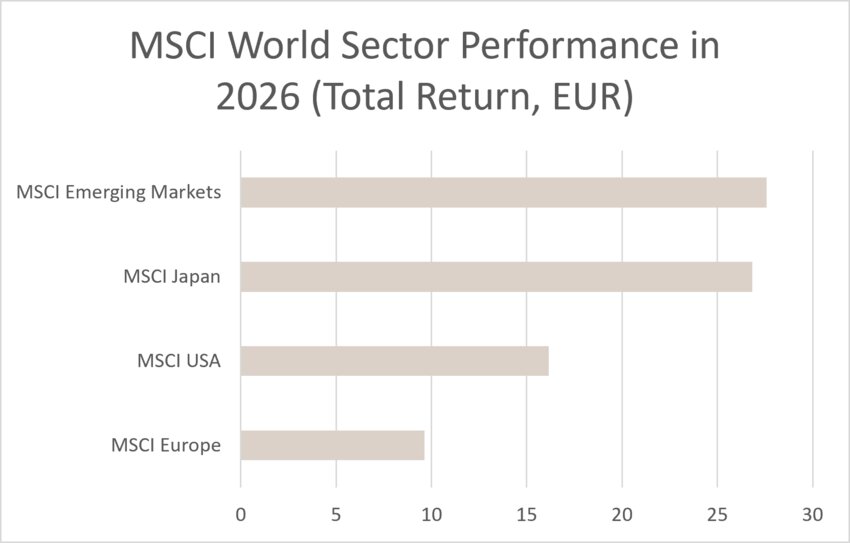
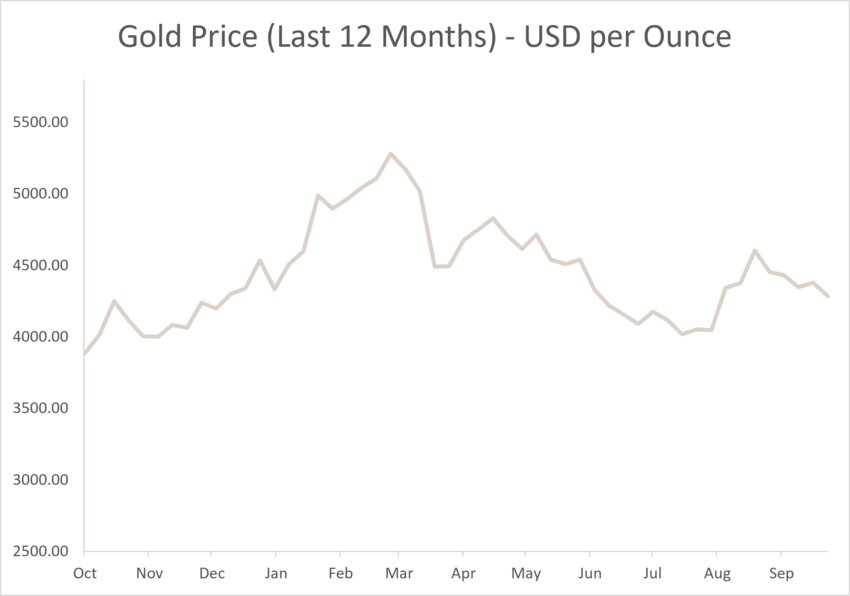
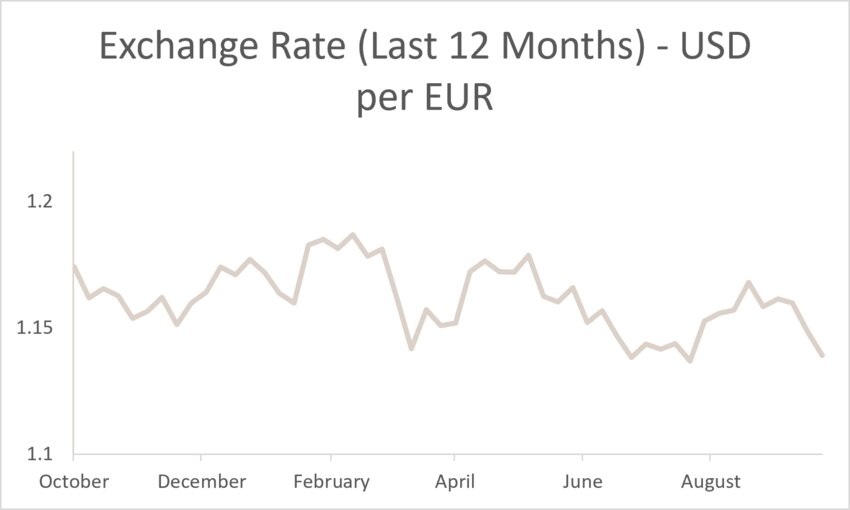
Stock markets
In September, the sharp rise in bond yields, persistently elevated oil prices, and geopolitical tensions did not prevent markets from showing resilience. The strength of the U.S. economy and corporate earnings prospects helped contain valuation pressures, while continued investment momentum in artificial intelligence supported large-cap technology stocks.
From a sector perspective, Technology outperformed. By contrast, Real Estate, Utilities, and Small Caps suffered from rising financing costs. Consumer Discretionary and Consumer Staples also weakened amid deteriorating household confidence and persistent concerns regarding purchasing power. Healthcare proved relatively more resilient thanks to the visibility of its earnings growth. As a result, the resilience of broader market indices continues to mask a performance dynamic that remains highly concentrated among large growth stocks.
Conviction in the artificial intelligence theme remains strong, although mixed reactions to corporate earnings releases call for greater selectivity. A preference is maintained for semiconductor companies, while also identifying opportunities among software providers capable of demonstrating tangible AI monetization and improving profitability.
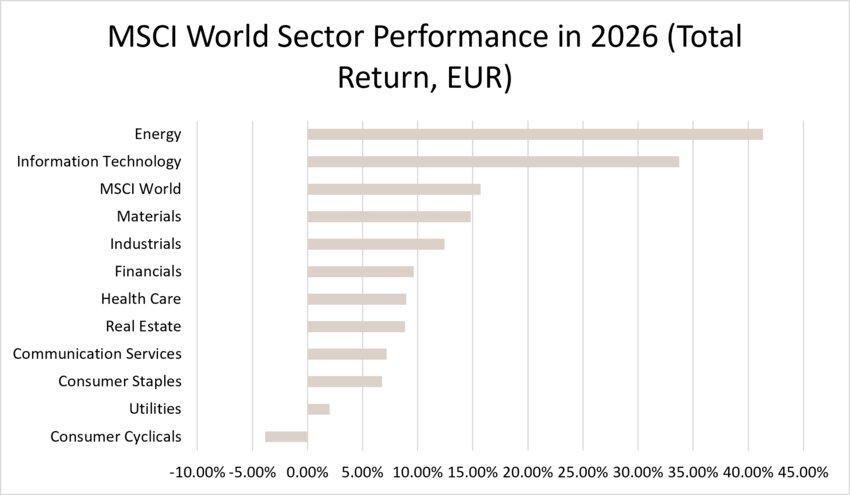
Sovereign yields and credit market
In September, bond markets experienced another period of tension, again largely driven by developments related to the Middle East conflict and energy prices. Inflationary pressures, combined with consistently resilient economic data, reinforced expectations of tighter monetary policy and pushed sovereign yields to fresh highs. Short-lived periods of relief emerged on hopes of a potential agreement with Iran, but these were insufficient to reverse the broader trend.
In the United States, yield increases were particularly significant. Initially, strong employment data, firmer-than-expected core inflation, and higher oil prices drove rates upward. Subsequently, the Federal Reserve confirmed this shift in regime by raising rates by 25 basis points to 3.75%-4.00% on September 16, marking its first rate hike since 2023. Furthermore, comments from the Chair and other policymakers suggested additional monetary tightening could follow. After a brief rally following the meeting, yields quickly resumed their upward trajectory, fueled by renewed energy-related concerns and strong economic indicators. As a result, the U.S. 10-year Treasury yield ended September at 5.28%, up 53 basis points over the month and at its highest level since 2007, while the 30-year yield exceeded 5.6%, a level not seen since 2002.
In the euro area, yields also rose markedly, as the region remains particularly exposed to higher oil and gas prices. The ECB raised its deposit rate by 25 basis points to 2.50% and adopted a hawkish stance, emphasizing that inflation is likely to remain above target for an extended period. Consequently, the 10-year German Bund yield ended September at 3.58%, up 26 basis points during the month.
France underperformed significantly. In addition to the pressures affecting the euro area as a whole, concerns surrounding French public finances weighed on sentiment. The 10-year OAT-Bund spread, which stood near 85 basis points at the end of August, widened steadily to reach 127 basis points by month-end, its highest level since 2012.
In credit markets, spreads generally widened, with Europe and High Yield significantly underperforming. In the United States, Investment Grade credit remained relatively resilient, widening by only 1 basis point to 80 basis points, while its European counterpart widened by 10 basis points to 91 basis points. The move was far more pronounced in High Yield. U.S. High Yield spreads widened by 46 basis points to 311 basis points, while European High Yield spreads widened by 41 basis points to 321 basis points, with the deterioration accelerating toward the end of the month.
Disclaimer
The recommendations contained in this document are, unless otherwise expressly stated, those of Spuerkeess Asset Management and are produced by Carlo Stronck, Managing Director & Conducting Officer, Aykut Efe, Economist & Strategist, Guillaume Gehant, Portfolio Manager and Martin Gallienne, Portfolio Manager, acting under an employment contract with Spuerkeess Asset Management.
Spuerkeess Asset Management is an entity supervised by the CSSF (Luxembourg’s financial sector supervisory authority) as a UCITS management company able to provide discretionary portfolio management and investment advisory services.
All external sources (financial information systems, Bloomberg and Refinitiv Datastream) are, unless expressly stated in the recommendation itself, deemed reliable, it being understood that Spuerkeess Asset Management cannot, however, fully guarantee the accuracy, completeness or relevance of the information used by these sources. The information may be either incomplete or condensed and cannot be used as the sole basis for valuing securities.
The valuation of financial instruments and issuers contained in this document is based on data provided by Bloomberg. The full description of the valuation method used by Bloomberg is available at www.bloomberg.com.
Any reference to past performances should not be construed as an indication of future performances. The price or value of the investments to which this document refers directly or indirectly may vary at any time against your interests. Any investment in financial instruments entails certain risks of which Spuerkeess (Banque et Caisse d’Épargne de l’État, Luxembourg) has been informed beforehand, such as the loss of the investment made.
With a view to providing these recommendations to Spuerkeess, Spuerkeess Asset Management has verified all relationships and circumstances that could reasonably be likely to undermine the objectivity of the recommendations contained in this document and confirms the absence of interests and conflicts of interest relating to any financial instrument or issuer to which the recommendations relate directly or indirectly, as well as those of the persons involved in producing these recommendations.
Recommendations are made on the date indicated on the first page of the document and were first released on the same date. The recommendations contained in this document may, where applicable, be used and therefore updated when Spuerkeess Asset Management next provides investment advice to Spuerkeess.
All recommendations sent by Spuerkeess Asset Management to Spuerkeess over the past twelve months may be consulted directly and free of charge at Spuerkeess Asset Management’s registered office, 19-21 rue Goethe, L-1637 Luxembourg. The information to be consulted shall include the date of dissemination of the recommendation concerned, the identity of the individual(s) involved in the production of the recommendation, the target price and the relevant market price at the time of dissemination, the direction of the recommendation concerned and the period of validity of the target price or recommendation.
The information contained in this document cannot be used as the sole basis for valuing securities and this document does not constitute an issue prospectus.
This document is for information purposes only and does not constitute an offer or solicitation to buy, sell or subscribe. Spuerkeess Asset Management may not be held liable for any consequences that may result from the use of any of the opinions or information contained in this document. The same is true for any omissions.
Spuerkeess Asset Management does not accept any liability for this document if it has been altered, distorted or falsified, particularly through online use.