The ESG exclusion policy sets out the principles, governance and criteria used to identify and exclude activities, sectors and companies deemed incompatible with Spuerkeess’ sustainability commitments. It contributes to limiting the potential negative impacts arising from its investment and advisory activities.
The asset classes, products, services and activities covered by these exclusions are:
Investments in securities for own account
Discretionary portfolio management / universe of eligible financial instruments
Investment advice / advisory universe
This ESG exclusion policy complements the exclusion measures already applied by the Bank, in particular those related to international sanctions, embargoes and other regulatory restrictions, ensuring a comprehensive and consistent risk management approach.
The activities not covered by these exclusions are:
Clients and investors acting on a “self-execution” basis, who may continue to carry out transactions in the securities concerned
Current accounts / deposits that the Bank will continue to accept
Instruments classified as sustainable (e.g. instruments meeting ICMA / CBI standards such as a Green Bond), even if issued by a company whose activities would otherwise be excluded
Portfolio management delegated to ODDO BHF (Private Banking)
Equity participations held by the Bank
For investment funds managed by Spuerkeess Asset Management (S-AM), S-AM applies an exclusion policy aligned with Spuerkeess’ policy for Luxfunds-Bond Global Green and Luxfunds-Equity Green. For other funds, exclusion criteria also apply, with the exception of those related to the oil and gas sectors.
For investment funds not managed by S-AM and for ETFs, the exclusion policy of the underlying management company applies.
At this stage, the policy does not apply to the loan and credit portfolio due to the lack of sufficiently homogeneous and reliable ESG data, particularly for SMEs.
The exclusion policy is a key lever for managing sustainability risks within Spuerkeess. It translates the Bank’s sustainability risk appetite into operational requirements and aims to limit exposure to sectors and counterparties presenting environmental, social and governance risks that are not aligned with its sustainability commitments.
It primarily focuses on climate and environmental impacts and consists in excluding:
Counterparties, sectors and activities causing significant environmental harm (“significant harm”) or generating material adverse impacts on climate or the environment (sector exclusions)
Counterparties involved in controversies related to the respect of fundamental human rights and principles (controversy-based exclusions and reputational risk)
To implement its exclusion policy, Spuerkeess relies on data and alerts relating to companies whose securities it holds or recommends to clients.
As Spuerkeess is subject to the Corporate Sustainability Reporting Directive (CSRD)¹, this policy also forms part of the transparency requirements under the CSRD and the European Sustainability Reporting Standards (ESRS)², which define the disclosure rules on sustainability-related policies and actions for material topics identified by the Bank.
¹ Corporate Sustainability Reporting Directive
² European Sustainability Reporting Standards
A dedicated “ESG Exclusion” group has been established within the Bank to manage exclusion cases. It is notably involved in the analysis of controversies and issues an opinion.
In case of disagreement between members of this group, the Bank’s second line of defence makes the final decision.
Members of this group are also consulted for the development and periodic review of the exclusion policy.
The Sustainability Committee of Spuerkeess is responsible for providing recommendations on potential updates to the policy prior to its submission for validation by the Executive Committee.
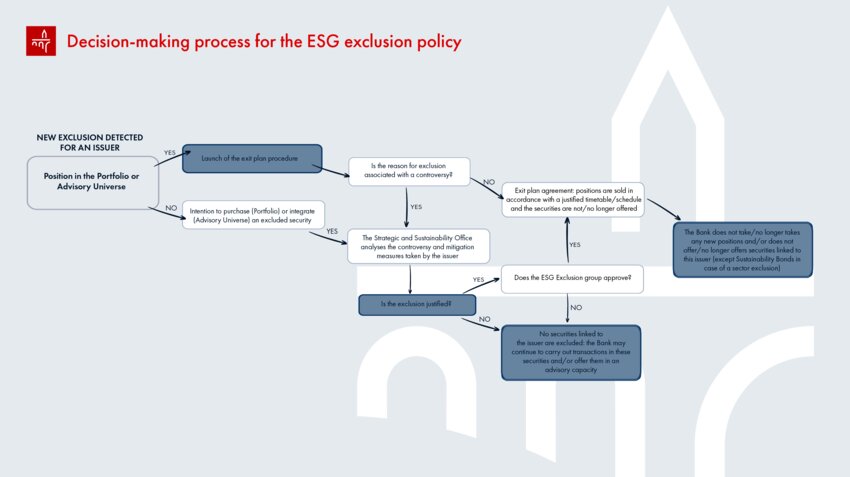
1) Exclusion rules
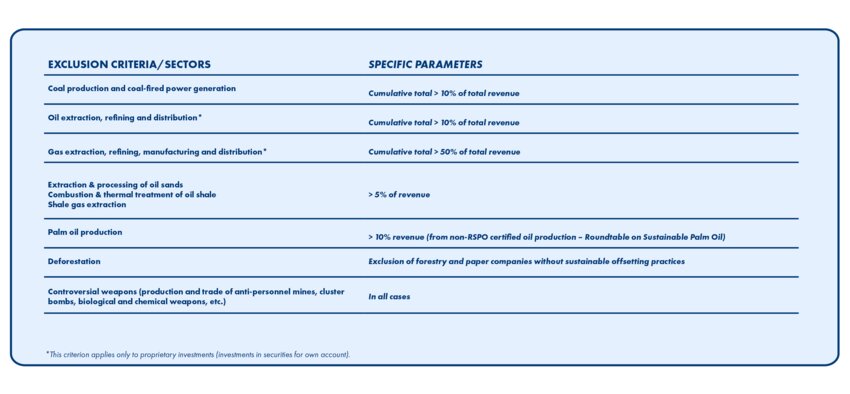
Sector exclusions
Excluded assets become eligible again for investment, without any moratorium, once the issuer’s activities no longer fall within the exclusion parameters.
Controversy-based exclusions
Excluded assets become eligible again for investment, without any moratorium, once the controversy that triggered the exclusion no longer meets the defined criteria.
Exclusion criteria are based on assessments provided by external ESG data providers, including alignment with the OECD Guidelines, and on analyses carried out by the United Nations Global Compact (UNGC).
2) Grandfathering
A “grandfathering” clause allows consideration of situations where the Bank already holds positions in newly excluded counterparties.
An exit plan is defined, following consultation with the relevant departments, which may result in actions ranging from immediate divestment to holding the position until maturity.
The ESG exclusion policy, and therefore this statement, is reviewed at least annually or whenever required by evolving market practices and/or regulatory developments.
This review is carried out following updates to the Risk Appetite Framework (RAF), to ensure that exclusion criteria and principles remain fully aligned with the Bank’s defined risk appetite.